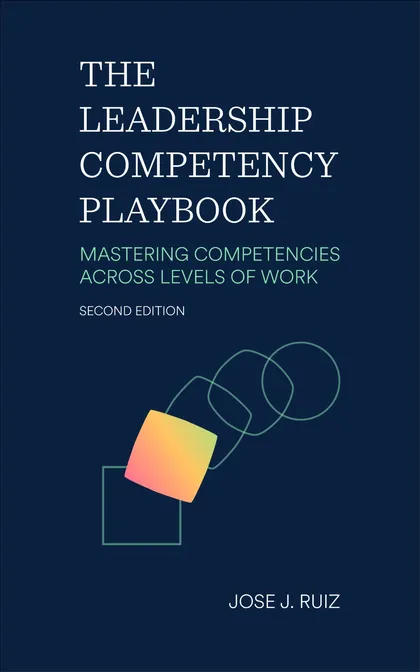
Second Edition

The Leadership Competency Playbook

Mastering Competencies Across Levels of Work

Most execution problems are direction problems wearing a different name. This book gives leaders the precise language to tell them apart, and the structure to fix the right one.

The Leadership Competency Playbook — Mastering Competencies Across Levels of Work

Organizations rarely fail from a lack of effort. They fail when people are asked to compensate, with personal energy, for choices that were never made clearly upstream. A missed delivery date, a quality slip, or a frustrated board often looks like an execution failure, but the real fault usually sits earlier, in direction that was never set with enough precision to survive contact with real work.

The damage compounds because the vocabulary leaders reach for under pressure has gone soft. Leadership gets asked to mean charisma, control, communication, and moral posture all at once. Management is dismissed as bureaucracy. Ability, capability, and capacity get used as if they were synonyms, and once those distinctions blur in conversation, they blur in hiring, promotion, and succession decisions that shape an organization for years.

This second edition responds by rebuilding the book's architecture rather than adding decoration. Every competency is now read through Levels of Work, so the same discipline is shown changing shape as horizon and complexity rise. The Triad of Direction is made explicit, separating reliable execution, direction-setting, and long-term continuity into three distinct disciplines instead of one overloaded word.
Second Edition

The Second Edition's Architecture

DOES is not a sequence reserved for executives at the top of an org chart. It is a cycle of Design, Organize, Execute, and Sustain that recurs at every level of purposeful work, from a frontline shift lead to a board committee.

01

The DOES Cycle

Design turns complexity into coherent choice. Organize converts that choice into workable capacity. Execute makes commitments visible through delivery. Sustain renews what must endure. All four are always in motion somewhere in the organization.

02

Levels of Work

The same competency word names a different discipline depending on the horizon behind it. This lens explains why a skill that looks procedural at one level becomes architectural at another, using Time Span of Discretion as its anchor.

03

The Triad of Direction

Management, Leadership, and Stewardship are three distinct disciplines, not synonyms. Naming which one a moment actually requires prevents organizations from asking one word to do three jobs at once.

The DOES Model

Design · Organize · Execute · Sustain

Dimension 01

Design

Turning complexity into coherent choice

Design narrows possibility into direction, so the organization can commit to a future it can actually carry.

6 competencies

Explore this dimension

Dimension 02

Organize

Turning chosen direction into usable capacity

Organize converts a chosen direction into roles, decision rights, resources, and rhythms the system can actually carry.

6 competencies

Explore this dimension

Dimension 03

Execute

Where commitment meets consequence

Execute converts intention and structure into visible delivery, adaptation, and results the organization can be judged by.

6 competencies

Explore this dimension

Dimension 04

Sustain

Renewing what must endure without losing what matters

The work of preserving continuity, developing people, and validating that the organization deserves to keep going.

6 competencies

Explore this dimension

All four dimensions →

Levels of Work

Why the same competency changes meaning by horizon

The same word can name a different discipline depending on how long a person must hold judgment before results can be judged. Levels of Work gives that difference a structure instead of leaving it to guesswork.

Levels of Work
  1. Level 1 — Quality Immediate, same-day judgment
  2. Level 2 — Service Days to weeks, within policy
  3. Level 3 — Practice Months, across repeated cycles
  4. Level 4 — Strategic Development Multi-year, cross-functional
  5. Level 5 — Strategic Intent Long-range, organization-shaping

Who this book is for

  • Frontline leaders who want sharper language for handoffs, escalation, and where their judgment actually applies.
  • Functional managers who need to tell disciplined improvement apart from novelty for its own sake.
  • Executives calibrating how much weight direction-setting should carry against near-term delivery.
  • Board members and HR leaders making succession and promotion calls that hinge on level of work, not just track record.

What changed in the second edition

  • Every competency is now read through five Levels of Work instead of treated as a flat trait.
  • The Triad of Direction — Management, Leadership, Stewardship — is explicit rather than implied.
  • Level 3 and Level 5 each carry an internal split that sharpens diagnosis at the levels leaders misread most.
  • Language throughout has been tightened so familiar words stop absorbing meanings they were never built to carry.
The Leadership Competency Playbook — Second Edition

Second Edition — available now

Read the second edition

Twenty-four competencies, read through the DOES cycle and the Levels of Work. The full architecture, chapter by chapter.

Available in paperback and Kindle.